7 Apr
Campaign for the Book. West Cheshire Council Staff take Industrial Action.
 This blog has developed organically over the course of two and a half years. My daughter is now six and a half. We are acutely aware of the damage that has been done by testing young children too much. And too much too soon, as has been evidenced by the mistakes made with the early versions of the Early Years Foundation Stage (which has now been reformed) – the coalition government’s proposed league tables for five year olds (which we managed as a grass roots campaign) to push back.
As parents we refused mostly wholesale the homework imposed on our child from the age of four – the testing and the tables. Instead we read stories to our daughter consistently and had conversations and followed and engaged with the guidance of fellow co-contributors to the book ‘Early Learning and the Erosion of Childhood’ which was published last year. We were in good company my daughter and I – collaborating with the best of early years educators internationally.
So it was an immense privilege for my daughter and I to stand on a picket line together with Alan Gibbons – children’s author today and founder of the ‘Campaign for the Book’. You see as parents we refused every test and measurement of our child that there was going – it came as no surprise to us that approaching the age of seven – our daughter has not only been awarded a prize for her descriptive writing at school – but is now amongst the VERY top of her class at spelling. How did that happen?
It happened in large part because as a family (and as a community) we love books. And accordingly, we love libraries. Stuff the tests. Libraries are free and have always been an important part of our culture. They are also a cheap, warm, safe and secure place to visit with small children (especially when the weather is cold or in the holidays).
So we supported our libraries today in Chester. West Cheshire Council staff (not just librarians) are currently taking industrial action see this link for video by David Holmes of the Chester Chronicle. It always amazes me how PR people in large organisations are often ignorant of the sheer unstoppable force of word-of-mouth communication. Alan Gibbons remembered how my Other Half campaigned on the miner’s strike twenty years before. There wasn’t much we needed to explain. Alan reminded us of how the U.K is twenty fifth in the Pisa rankings and planning to shut down many of it’s libraries. South Korea on the other hand I recall he said is number five on the Pisa list and they are opening more than one hundred new libraries.
So it seems as has so often been the case throughout history and across the world, those who love books are in the forefront of resistance to the canker that is the coalition. Joined in Cheshire West by Home Care Workers, Housing Network Staff, Parking Enforcement Officers, Park Rangers, Central Control Officers, CCTV Officers, Streetscene Operatives, Children’s Home Staff, Social Workers and Family Support Workers.
Cameron and co. who on earth do you think you are fooling?
Council Staff are taking Industrial Action – UNISON PRESS RELEASE FOLLOWS:
Staff across all Council Services are currently on strike over the Easter holiday period. 100’s of staff have been forced to take strike action following the rejection by the Council of new proposals that would have avoided this disruption to services across the Borough. The Council by rejecting new reasonable proposals from the trade unions that would have avoided this strike – have only made matters worse.
The issue:
This Council, unlike most others in the North West, has decided to remove the pay enhancements staff receive for working weekends, bank holidays and overtime. They are also cutting the rate for working nights.
UNISON believes that paying more for working nights and weekends is fair and proper. It reflects the real cost of working 6 days, missing family life and of higher child care costs.
All major employers make such payments. We are not prepared to see ours taken away because of a financial crisis we did not cause. We are already suffering redundancies and a 3 year pay freeze, which has cut our real pay by over 10 per cent.
In addition to that – the Council have actively sought to undermine the strike action by offering double pay to people who are prepared to undermine their colleague’s action.
Other Councils have all managed to negotiate with the trade unions – no other Council has gone this far; and we believe this is an ideological attack on the workforce.
If the Council had put as much effort into resolving this dispute, as it has into undermining lawful action, we would not be in this position today. We hope you will understand why we are forced to take this action and you will support us in the fight.
SOURCE: west cheshire UNISON.
15 Mar
The Truth about Academy Schools. Public Meeting Chester. The verdict.
Last night’s public meeting at the Mollington Banastre hotel with representatives of the NUT, the NASWT, ATL and UNISON went well. I was speaking as a writer and a parent and promised I would make the transcript of my talk available on this blog – for those who couldn’t make it – or for those who want to add to and continue with the discussion.
Copy Follows:
I’ve been asked to give a short talk. Initially I chose ‘The potential impact of academies on parents and children’ as a heading and then quickly realised how ridiculous a title it was – more like a dissertation… so let’s narrow this down to:
‘Towards an analysis of the potential impact of academies on parents and children’.
This title kind of implies that we’re on the way but we don’t have all the answers…(if like me you’re a stressed out parent and you nod off during this talk – you can catch up with it later on www.parentsguidetoeyfs.wordpress.com
I wrote a chapter for a book on education last autumn. The book is “Too Much Too Soon – Early Learning and the Erosion of childhood’. The chapter was called “A Parent’s Challenge to New Labour’s Early Years Foundation Stage”.
I described how a new parent (or a parent who is new to a particular school) may not know how the school system (and the individual school) works. This is also highly relevant to any discussion on academies – parents are subjected to a great deal of propaganda – about the system itself and about systems-within-the-system such as the Early Years Foundation Stage).
Where does this propaganda come from? In simple terms it is created by
a) The government
b) The government and businesses sending PR and targeted press releases to the media which some journalists no longer have the time to analyse properly as they should. Funding for investigative journalism is increasingly difficult to find.
c) Local authorities (following the government line)
d) And schools themselves (websites, PR) e.t.c.
Of course parents are savvy and inventive, they were not born yesterday – but many of us nonetheless find ourselves in an extraordinary vulnerable position as far as sending our children to a particular school is concerned. Personally I feel you never really know what a school is like until your child has been there for a good while or until you start to work there yourself, as a member of staff.
I’ve been asking parents about academies locally and writing about it. I spent a day in the company of parents from Shore fields Academy as they protested at the University of Chester and at Chester Town Hall. You’ll find an account of what they had to say on the blog mentioned above – I heard many different voices – most of them said the same thing: “There was no consultation” – “Not one person wanted this” – and having lived through the experience of seeing their school turned into an academy one parent summed things up: “What we are seeing now in our society is institutionalised corruption”.
Our daughter is six and she attends xxx primary school. I would not have said when she started there that it was a good school. Our current headmistress with whom I have had a great many interesting (and often difficult) discussions about education – together with her team – is succeeding in improving the school.
When my daughter started there some years ago – parents were kept at a distance – outside the gate – quite literally even when it was pouring with rain we were no allowed in to the school gates at pick up time. We didn’t even have a parent teacher association. There was a lot of bullying.
And then the culture started to change. School staff asked parents for their opinions, parents took part in all manner of events, maths days, school garden project, people started to relax more and work together more there were visible improvements. Parents teachers and head navigated their way through the painstaking process of forming a PTA and in the first year won a national award from the National Association for PTAs. I mention all this as in academy schools systems of governance in contrast appear to be undemocratic.
I’m not going to reiterate the detailed and excellent arguments put forward by the unions. I’ve noticed that some assume that I am against all academies and free schools per se. I’m not sure I am. What I’m saying is more pragmatic than that something more like “if it ain’t broke then don’t fix it”.
State schools can work and they do work. I believe that as long as parents work together with the school, as long as their suggestions are really listened to, taken up AND mechanisms are in place for criticisms to be listened to and parents are not marginalised – they can be effective and happy places. Yes, we need to change govt. policies and I will never agree with some aspects of the state school system as it stands for example sending school to school at four is far too early (the arguments on the one are in the book I mentioned – fellow co-contributors include Barry Sheerman the former chair of the government’s education committee and many international childhood experts.
As a parent the thought that our state school might be turned into an academy is dreadful. As is the thought that when my daughter is ready to start secondary schools there will be no state schools left – only academies to ‘choose’ from.
As a writer I have received testimonies from parents (and teachers) who are experiencing unethical behaviour in academies locally. Here are some examples:
– One new teacher in an academy had been working for free for six months (the equivalent of a workfare scheme in education).
– Examples of teachers completing student’s work themselves in order to meet targets
– Examples of classroom assistants being used as substituted teachers for project work inappropriately.
– Putting children with attention span problems in a 2 to 3 hour lesson
– Financial mismanagement – which favoured senior management salaries whilst leaving teaching staff without the necessary resources to teach effectively (no equipment for sessions e.. books)
– Academies cannot be put into special measures – so make an academy which fails and you are effectively creating a failing academy that can’t be failed. (N.B after having given this talk, someone queried this – so I would be glad of any comments to clear this one up).
– There are huge problems with behavioural issues – it is difficult enough to tackle bullying in a state school which has access to local authority resources but without local authority anti-bullying resources – the problem can get worse. One teacher in an academy said: “As a subject lead I experience some incidents/problems with my classes. however I am constantly interrupted by incidents in the department. I do not blame staff for his as the pupils have nowhere else to go – The punishment for verbal abuse and physical assault in totally unacceptable as i is for repeat behaviour and escalation in behaviour. Levels of abuse are tolerated, pupils are openly defiant there is complete confusion over roles and responsibilities.
I’m sorry that more parents from our school were not able to join the discussion tonight. I often think that most of the activity around a public meeting happens by word of mouth – when people go home and tell their friends (at the school gate). Some are double booked we have a PTA meeting tonight.
Having spoken about the positive sides of PTA’s I need to add a word of warning as far as academies are concerned. There is a degree of pressure right now to reduce the role of PTA’s to fundraising and to try to exclude topics from the agenda that are perceived to be ‘political’ or ‘ideological’. We’ve come up against this issue quite a number of times in ours. One example: we objected on religious, ideological and political grounds to our child being asked to ‘dress to impress’ on the day of the Royal Wedding – and were promptly told by a fellow PTA parent that if we didn’t like it we should ‘go to Libya’.
PTA’s need to be aware that ‘dissent’ is the cornerstone of democracy itself. The model PTA constitution offered by the National PTA association states that PTA’s exist not only to fund raise but also their primary purpose is to ‘further the children’s education’. To my mind this should include a discussion of the wider influences on schools such as academies. Schools have a legal obligation to actively further the involvement of parents in their children’s education.
I believe that academisation, the setting up of free schools locally and nationally will not ‘raise standards’ but lead to a deterioration in the essence of what education is truly about – it will lead to an over emphasis and further obsession with target culture.
Education should be about asking questions and finding answers, investigation, creativity and yes, in a positive sense – discipline .
Education should be about substance and NOT spin.
My other half, my daughter and I are proud to be long-standing members of Cheshire West against the Cuts. I have to say apart from being extremely hard working, the people involved are compassionate and caring. I mention this fact for a reason. We need to fight the cuts on all fronts and I believe that truth and the moral imperative is on our side. At a packed meeting of Chester Disabled People Against the Cuts my husband Richard Atkinson described what the government is doing to essential services as ‘evil’. He is an atheist, but his speech would not have been out of place in my Wirral and Chester Quaker Meeting.
He said the government cuts in the NHS health and social care were ‘evil’ because they were prompting people to accept the idea that is somehow alright to stop seeing people as human beings at all. That it is okay to judge every adult and every child – according to whether or not they can do certain tasks – and in doing so reduce human beings to a set of ‘outcomes’.
There is much more to say about this obviously than is possible in ten minutes, but the truth about academies I believe is that they will do nothing to reverse this trend.
It’s really not that complicated. The following quote came from a resident of Haringey not connected with education.
“If you have a flourishing school and if parents and teachers are happy with it, what is Mr Gove’s problem? It is his horrible Etonian ideology that wishes to privatise education so that his mates can get a cut: same with the NHS really.”
Copy Ends.
14 Mar
Public Meeting Chester: The Truth about Academy Schools
I’ve done it again – agreed to speak at a public meeting I mean.
In Chester this evening on “The Truth about Academy Schools”. Wasn’t at all nervous until people started saying: “Rather me than you” 🙂 ?
It’s organised by Chester Trades Council and supported by trades unions ATL, NASUWT, NUT and UNISON. The venue is the Mollington Banastre Hotel, Parkgate Road Chester and if you need the post code for your Sat Nav it is CH1 6NN.6.30 p.m for 7.00-8.30
Everyone is welcome apparently, parents, teachers, school support staff, any interested parties…for those that keep an eye on such things it is quite a posh venue – with free parking and refreshments. And, (I’m told) some sort of facility for children. So not having a babysitter is no excuse, guys and gals. The flier says: meet representatives of the Trades Council, ATL, NASUWT, NUT and UNISON. And me. Speaking amongst other things as a member of the largest non-unionised work force in the U.K. (mothers).
Would have liked to have done more research but since the slot is only fifteen minutes maximum one has to curtail it to a certain extent. In my head and in the background I’d been trying to find the main link between the push for academy schools and pressures on children in the early years. I think I found it in a very fat NASUWT report called ‘Academy Schools Case Unproven’. Legally speaking and to be very basic about it young people have far fewer human rights in academy schools.
Of course, for all those mums dads and carers out there – just remember parent power counts for a great deal and in fact, although we are often ignored the government has to think twice about their policies if we shout loud enough. So if you can join us this evening. If you can’t I’m publishing my speech on this blog later this week so you can tell me what you think via the comments box. Wish me luck, eh and tell your friends. Here is a link to a flier:
Chester Public Meeting The Truth about Academy Schools
1 Feb
On the Free School Primary planned for Chester Cathedral (and shortcomings).
Okay I know, I haven’t written on this blog for a good while. Excuse being writer’s block brought on by various events, some or all of which were highly political. Also, being a bit of a blog perfectionist – posts sometimes appeared disparate and unconnected with each other. It made sense to me – but as far as the readership goes – I’ve got some joining-up to do perhaps?
It all seems to come together when you look at the Free School Primary planned for Chester Cathedral and the questions which no-one seems to be asking (yet).
The first question one might ask is: “How does the planning of such a school impact on other primaries in the area?”. (West Cheshire). Let’s just attempt a draft answer shall we? It seems to be the case that if the plan goes ahead less money will be available for other schools in the area. I have sources which indicate this is the case – so will update this blog post perhaps to include some of these.
The second question – most relevant to an early years blog – is – how will the (flawed) Early Years Foundation Stage be implemented in this school (?). I’m assuming since the EYFS is ubiquitous and statutory requirement that this will be the case – unless the school plans to apply for an exemption…
Question number three: How did it happen that the front page of our local newspaper featured a report on the Chester Cathedral Free School Plan – which resembled a paid-for advertisement for such a school, rather than a journalistic analysis of whether or not such a school would be a good idea? See the Chester Chronicle’s Ambitious plans for first ever free school in Chester.
And question number five: Bearing in mind that it is Wednesday today – and I have only just got wind of a ‘public consultation event’ – scheduled for next Monday at the Chester Cathedral site –
(University cathedral free school Community Consultation event Monday 6th February 7pm 11 Abbey Square) how can this event apparently arranged at short notice – and the lack of adequate publicity offer the general public a chance for any really democratic consultation?
Question Six: How does the Chester Cathedral free school plan connect with the three-quarters-of-a- million pounds scandalously wasted on a proposed (and botched) – ‘improvement scheme’ described on this site? (See: Chester Cathedral Free School background and history).
And last but not least: How does the Chester Cathedral Free School proposal connect with Michael Gove’s announcements this week? http://www.guardian.co.uk/politics/video/2012/jan/31/michael-gove-education-standards-video
More questions than answers…anyone out there – wish to comment?
26 Sep
Early Learning and the Erosion of Childhood. Book launch hits Telegraph front page.
Saturday’s Telegraph front page slot featured an unusual education headline: “The erosion of childhood”. A front page article featured a historic Open Letter signed by more than 200 specialists and parents which detailed how the space children have to grow, thrive and play is being eroded by commercialisation, target setting and testing. As a freelance journalist, parent and writer – I signed the letter too.
Also mentioned was the book of the same name to which I have contributed a chapter – which has already been referred to as ‘the most important book of the year’ on education. Early Learning and the Erosion of Childhood. The press coverage, the debate and the public information campaign called for – are directly relevant to government cuts in education and child care.
13 Sep
“Too much too soon – early learning and the erosion of childhood” Book Launch
Two copies of the book I wrote a chapter “Too much too soon – early learning and the erosion of childhood” for reached me through the post yesterday. No exaggeration to say almost everyone I know would like to read it (and I wish I had hundreds of copies to give away for that reason). It has been described by Professor Janet Moyles said: “Surely the most important book on children’s learning and well-being published this year”. Here is the link again if you would like to buy or order it for your local library: “Too much too soon – early learning and the erosion of childhood”. Follow the links for a complete table of contents – that way you can see exactly what you are buying. There is so much ‘meat’ in and around the book – the launch feels like a slow burn so over the next few weeks I’ll keep readers posted on activities around it. Feedback on the book of course very welcome!
29 Jul
New Blog launch: M.S. in the family: a community perspective.
Launched a new blog – called M.S in the family. I’ve already had some international and local responses. A few hiccups with the new Mr. Site platform (the links are much more difficult to do than WordPress) – it will be of interest to all those with disabilities and M.S. and especially parents with M.S. and their children. There is a fair smattering of politics in it and what I hope is an interesting post on an anti-cuts meeting with relevance to disabilities. Check it out sign the guest book and wish me luck! Here is the link again: www.misinthefamily.com
27 Jul
Disabled People Fight Back against the Cuts. Campaign Meeting Dial House Chester tonight.
WEDNESDAY 27TH JULY, 6PM at DIAL HOUSE, HAMILTON PLACE, CHESTER. Union reps, carers and supporters of people with disabilities also welcome. Try to get your union to send a rep of you can. Also parents of children with disabilities. There will be at least one child at the meeting, it is early evening so if you don’t have a babysitter, bring your child along with some toys or something to do. No creche though but between us we’ll manage!: Too many disabled people are living in fear of coalition government cuts which threaten our independence, our care and our benefits. Government proposals will mean: …* the abolition of non-means tested benefits like Incapacity Benefit from April 2012 * the abolition of Disability Living Allowance from 2013 * strict policing of all benefit claims by privatised medical services (ATOS) who view all disabled people as potential criminals * cuts to support services from local authorities * cuts to housing provision * privatisation of the NHS. And all this is accompanied by a wave of attacks in the media. Government ministers try to smear disabled people claiming their rights as welfare cheats or drug addicts. It is time for disabled people themselves to make their voices heard in opposition to the cuts. There will be a meeting in Chester to start a campaign of protest here: WEDNESDAY 27TH JULY, 6PM at DIAL HOUSE, HAMILTON PLACE, CHESTER ALL DISABLED PEOPLE IN AND AROUND CHESTER ARE WELCOME TO COME AND HELP. ALSO CARERS. PERSONAL ASSISTANTS, PARENTS AND SUPPORTER
19 Jul
Shorefields Secondary Anti-academy Protest hits Chester.
Arriving at the University of Chester around 11.30 a.m this morning, the passengers on the double decker bus from Shorefields Secondary School filed out and assembled. Yet another protest against the drive to make their school an academy. I listened to many different voices – most of them said the same thing: “There was no consultation” and “Not one person wanted this”. What we are seeing now in our society, one protestor said – is ‘institutionalised corruption’. Children, parents, trade unionists, teachers and classroom assistants showed a united front and had brought with them a petition which they handed over the to the Vice Chancellor of the University of Chester via the reception desk of the University.
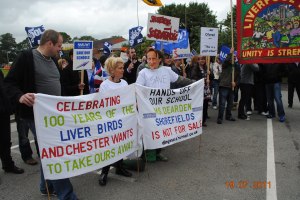
- Shorefields Liverpool comes to Chester. Anti-academy protest. University of Chester. Photograph Frances Laing.


NUT Banner. Shorefields Anti-academy protest University of Chester. Photograph Frances Laing.
Parents told me something about the school. A school with good Ofsted ratings. A school particularly reliant on community support, a community school – with double the national average of children with Special Educational Needs and five times the national average for free school meals.
A school where price rises for essentials like school uniform are a difficult challenge for many, especially those with more than one child at the school. Under the new academy regime I was told a blazer would cost £40 and an outdoor p.e. kit shirt alone would cost £25.
Protests have been covered extensively in the Liverpool Echo and the Liver press, but this time protestors were on a ‘Day Out’ in the style of the playwright Willy Russell, to show Cestrians what the academies story really is and how Chester University is at the forefront of the push to privatise our schools.
I was told the protests have seen five resignations by governors at the school.

Shorefields Anti-academy protest comes to Chester. Photograph Frances Laing.
One of the major funding issues with special educational needs was that in contrast to a local authority school – in an academy special educational needs funding is not ring fenced. Therefore if the school finances go down, there is no financial back up for this provision.

Shorefields Anti Academy protest outside University of Chester. Photograph Frances Laing.
University of Chester officials attempted to stage-manage the protest in PR terms leaving the majority of protestors in an empty hall – with all the banners propped up against the tables.
A hot drink had been laid on by the University of Chester but these seasoned protestors clearly had no intention of being bought out by tea and biscuits (come to think of it, in fact there weren’t even any biscuits). With a polystyrene cup of University tea in hand I heard how pro-academy forces-that-be had been slowly chipping away at the school’s reputation. A school that had been described as ‘good’ by Ofsted.

Shorefields Anti-Academy Protest University of Chester. Photograph Frances Laing.
Afterwards I accompanied protestors on the coach from the University of Chester to Chester Cathedral. (They had asked the Bishop of Chester to meet them to discuss their concerns).
Shorefields community clearly cares about itself and Shorefields butties were shared on board. Here was a community which was together. Not some theoretical kind of Cameron-esque big society but a real, big-hearted community in action.
Our own Chester city chiefs like to make a show of offering hospitality to visitors and each bus load of visitors can access a tour guide.
In contrast – the Shorefields Anti-Academy Protestors coach featured a police escort up front courtesy of Cheshire West and Chester Council.
Protestors kept their sense of humour, I had lost mine, I was just ashamed of our city at that point. The official reception seemed so shabby. It seemed our University never had any intention of listening to these parents, teachers and children – it was just seeing pound signs – just wanted them to shut up and go away. And seldom if ever do we hear about any of these things in our own local press.

Shorefields Anti-academy protest police escort. Photograph Frances Laing.
Undeterred, protestors left their double decker bus and headed confidently for Chester Town Hall Square steps singing a cleverly crafted anti-academy cover version of “We’re all going on a summer holiday”. It was a day to remember…and I felt privileged to be there.

Shorefields Anti-Academy protest heads for Chester City Centre. Photograph Frances Laing.
Local union officials stood ready to greet protestors on the Town Hall steps together with a spokesperson from the National Union of Teachers.
I believe the protest made the national news.

- Shorefields Anti-academy Protestors Chester Town Hall. Photograph by Frances Laing.


 A parent's guide to the early years foundation stage.